Subcontractor competence checklist. A printable checklist for assessing a subcontractor before they start — organisational capability, insurance, RAMS, the people they are sending and the evidence behind each.
This is the paper version. BuildOptix does the same job on a phone, with the record filed against the site and the operative automatically.
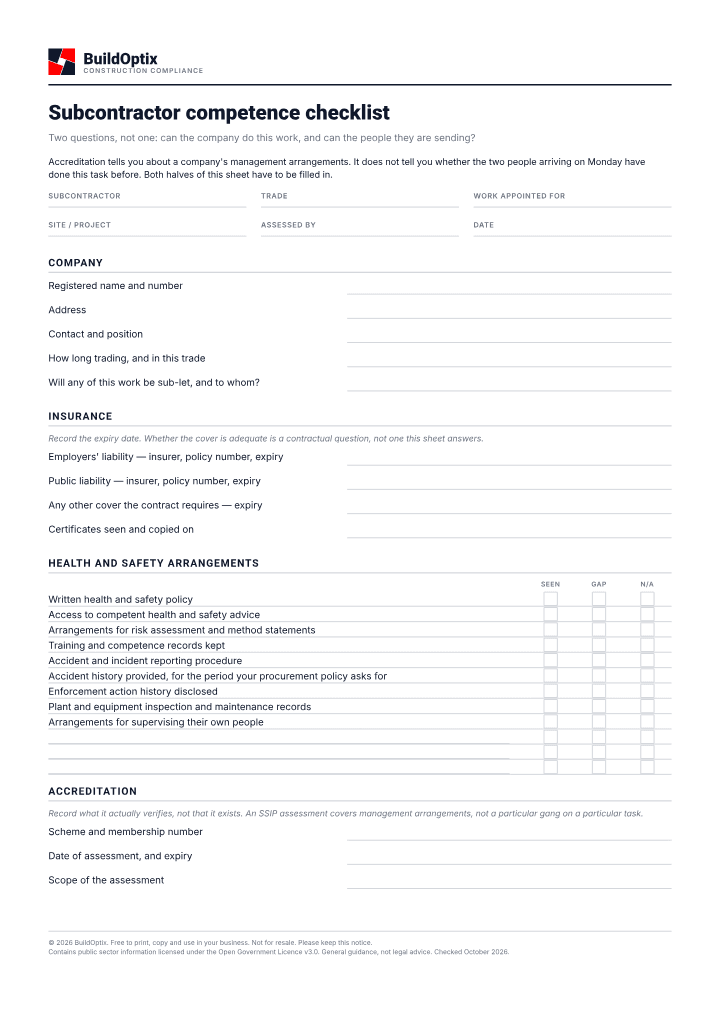
What is on the sheet
- Company details, trade, the work being appointed for and who is assessing them
- Insurance: employers' liability, public liability and anything the contract requires, each with an expiry date
- Health and safety arrangements: policy, competent advice, accident history and enforcement history
- Accreditation held, recorded as what it actually verifies rather than as a pass
- The people being sent: cards, tickets, training and whether the card matches the task
- RAMS received and reviewed before start, with a decision, an owner and a date
Why this record matters
CDM 2015 requires anybody appointing a contractor to take reasonable steps to satisfy themselves that the contractor has the skills, knowledge, training and experience for the work. In practice that becomes a folder of certificates nobody reads, which satisfies nothing and evidences less.
The distinction this sheet insists on is between organisational capability and the people turning up. A firm with faultless accreditation can send two people who have never done this task, and a sole trader with no accreditation at all can be the most competent person on site. The checklist asks both questions because the answer to one tells you nothing about the other.
Accreditation is recorded as what it verifies rather than as a tick. The SSIP schemes assess a contractor's health and safety management arrangements to a common standard; they are not a warranty that a particular gang is competent for a particular task, and treating them as one is the most common misreading in the industry.
Cards get their own line for the same reason. A card shows a scheme has checked something about that person — and what it has checked varies by card. It is evidence to weigh, not an answer, and a checklist that ticks 'card seen' has recorded that somebody owns a card.
Use it with
- RAMS templateA printable risk assessment and method statement — the hazards and controls on one side, the sequence of work on the other, and the briefing record that proves the gang was told.
- Site induction recordA printable site induction record — what the person was told, what was checked before they were let on, and their signature against it.
- Construction phase plan templateA printable construction phase plan pro-forma covering the project, the arrangements for managing it, and the significant risks and how they are controlled.
Read more on this
© 2026 BuildOptix. Free to print, copy and use in your business. Not for resale. Please keep this notice.
Contains public sector information licensed under the Open Government Licence v3.0. General guidance, not legal advice. Checked October 2026.